
A new study by the Memory Circuits and Molecular Engram teams, published in Nature Communications, reveals that memory-encoding cortical neurons functionally contribute to remote memory retrieval after a mild, but not strong, aversive event.
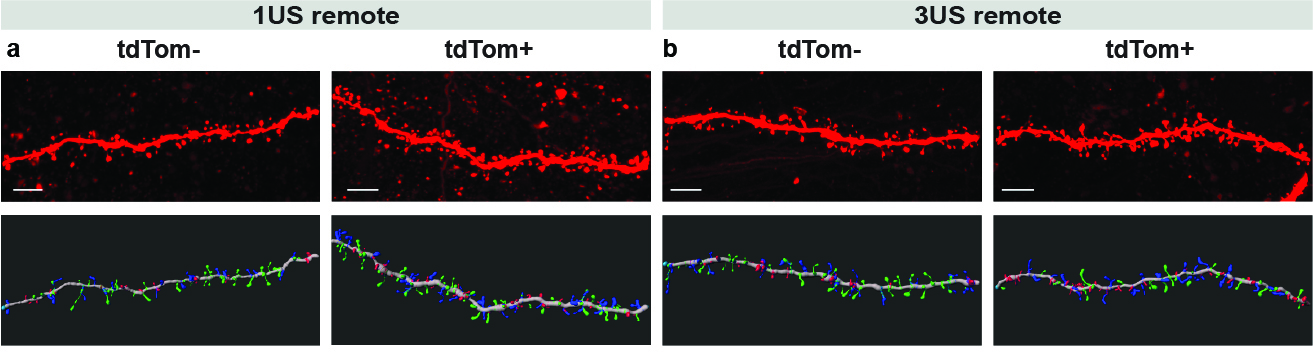
Postdocs Miodrag Mitrić and Sanne Beerens, in collaboration with PhD student Panthea Nemat and other members of the teams of Michel van den Oever and Priyanka Rao, genetically labelled cortical engram neurons in mice that were fear conditioned with 1 or 3 foot-shocks (1US – mild threat vs. 3US – strong threat, respectively) and compared them with mice that did not receive foot-shocks during conditioning. First, they found that cortical engram neurons are functionally involved in remote memory expression only after mild conditioning. Next, in a set of electrophysiological recordings and structural analyses of engram versus non-engram neurons, they observed that after mild, but not strong, conditioning, cortical engram neurons show a time-dependent increase in the density of long thin spines on their oblique dendrites, aligning with the selective causal contribution of these neurons to retrieval of a mild threat memory.
Together, this demonstrates that synaptic adaptations in cortical engram cells exhibit three key characteristics: they depend on (1) threat intensity, (2) the passage of time, and (3) develop in a dendritic segment-specific manner. As such, these findings provide strong support for (1) the functional engagement of cortical engram cells in expression of a mild threat memory, (2) their contribution to remote, but not recent, memory expression, and (3) increased potential for enhanced connectivity with afferents innervating oblique dendrites of these memory-encoding cortical neurons.
The image above shows examples of 3D reconstructions of dendrites and spines of engram (tdTom+) and non-engram (tdTom-) neurons.
Source: Threat intensity shapes cortical engram architecture supporting remote memory retrieval. Nature Commun 2026 Jun 11. DOI: 10.1038/s41467-026-74231-5