
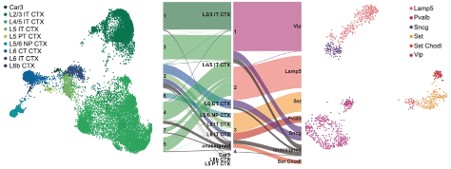
A new study led by Amparo Roig Adam (FGA) uses single cell sequencing to map effects of Stxbp1 haploinsufficiency across all brain cell types. The study, published in Molecular Psychiatry, provides potential new therapeutic targets.
STXBP1-related disorder (STXBP1-RD) is a severe neurodevelopmental disorder caused by de novo heterozygous mutations that lead to STXBP1 haploinsufficiency. STXBXP-RD is characterised by developmental delay, intellectual disability, early-onset seizures and autistic features. EEG analysis suggests excitation-inhibition (E/I) disbalance. However, STXBP1 is ubiquitously expressed in all neuron types studied so far, and it remains unknown how haploinsufficiency leads to E/I disbalance and STXBP1-RD symptoms.
The study used single-cell RNA-sequencing to characterize the effects of Stxbp1 haploinsufficiency across all brain cell types in the somatosensory cortex of a validated mouse model for STXBP1-RD. The relative abundance of cell types was normal, but many transcriptomic changes were observed throughout different cell types. The most prominent transcriptomic changes occurred in GABAergic and glutamatergic neurons, especially Sncg interneurons and deep-layer pyramidal neurons. Astrocytes exhibited substantial changes despite not expressing STXBP1, suggesting a non-cell autonomous response. Differentially expressed genes showed little overlap between neuronal types but accumulated in synaptic and translation-related GO terms. This was accompanied by a strong trend towards reduced protein translation as measured by puromycin incorporation. Excitatory neurons showed greater synaptic dysregulation than inhibitory neurons. Notably, neuronal transcriptome changes greatly overlapped with prior proteomics STXBP1-RD data but differed radically from other disorders. Seizure burden correlated positively in astrocytes and negatively in neurons to expression of translation-related genes.
This study identifies cell-type specific vulnerabilities to STXBP1 haploinsufficiency which may explain hyperexcitability, network dysfunction and cognition deficits in STXBP1-RD. Overall, the study provides a cellular-resolution map of the transcriptomic changes in STXBP1-related disorders, providing potential new therapeutic targets.
The full study is available as open source here.